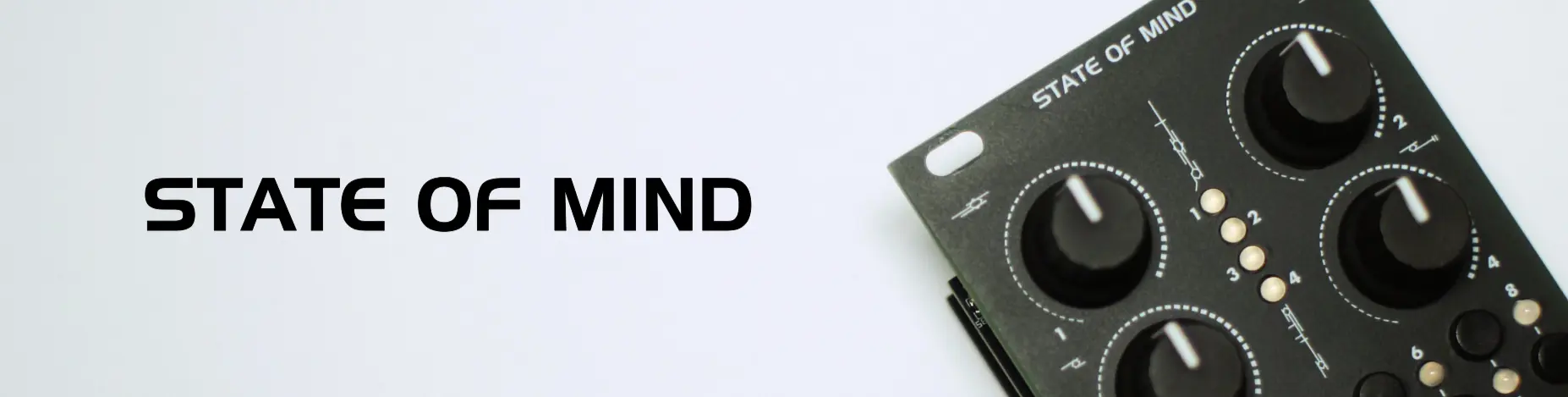
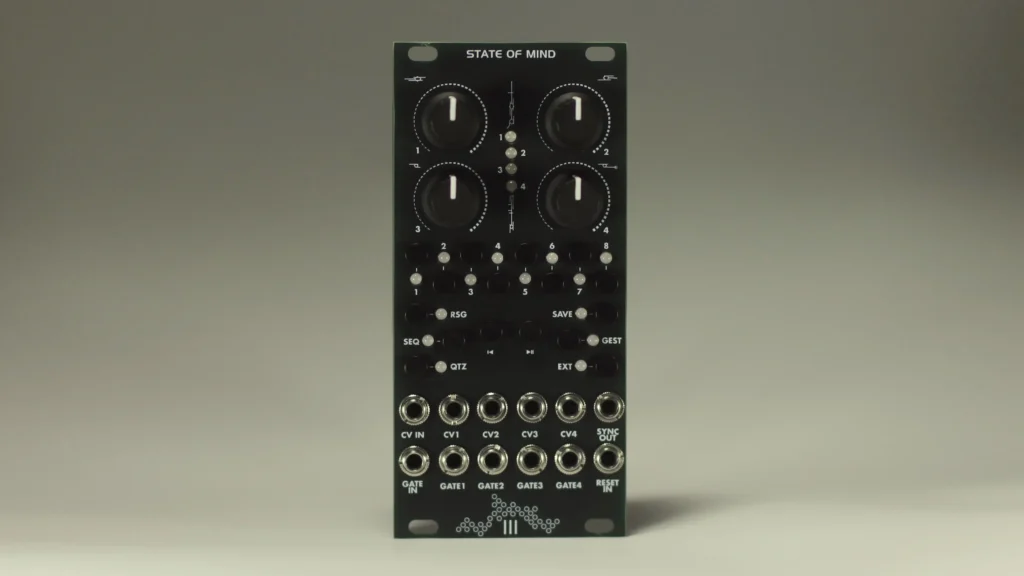
Tre Modular – State of Mind is Four-channel CV workstation. Four CV outputs, four gate outputs, and four engines that move them.
In a small case, State of Mind can be the whole brain: sequencing, writing melodies, and recording all in 12 HP. In a big one, it gives you four extra hands.
Here is a jam showing off State of Minds RSG engine.
Engines:
SEQ (Sequencer)
Steps through eight saved snapshots, each holding all four channel voltages, in any order. Jump, glide or morph between them in eight shapes, from one step every twenty seconds to twenty a second, with swing and four play directions. Each channel has its own clock division, shape, swing, gate pattern and gate length. Scenes save the whole setup. You can switch them or chain them into a sequence of sequences.
RSG (Random State Generator)
A melody generator that ranges from true random voltages, quantized or raw, to structured melodies that play like songs. Four voices, each with its own range, rhythm and melodic figure, playing together in chords, parallel fifths and octaves, held tones, answering lines, or each on its own.
GEST (Gesture and CV recording)
Records knob movements, and any CV and gate you patch in, as real voltage: 1,000 samples a second, up to 48 seconds per take, negative voltages included. Each channel loops its own recording. Layer them, save the four-channel arrangement to one of eight slots, recall it or chain slots into a sequence.
EXT (External control)
Lets an external CV, clock or keyboard play State of Mind, in seven ways. Each trigger can step through your snapshots in order, at random, or forwards and backwards with a CV; a voltage can jump straight to a snapshot or sweep smoothly through them all. The channels can also follow an incoming CV directly, or harmonize it. The clock input reads 1, 2, 4 or 24 pulses per step and drives the sequencer and RSG as well.
Utilities:
QTZ (Quantizer)
State of Mind can turn any channel into notes of a scale. Eight scales and twelve roots, with each channel free to have its own. It works on whatever drives the channel, from snapshots and the sequencer to an incoming CV.
VCO tuning
State of Mind can tune an oscillator to itself. Patch a channel into the oscillator’s 1 V/oct input and the oscillators output back into CV IN, and the module measures it note by note across eight octaves in about two minutes. Because every note is measured, it corrects tracking errors as well as offset, so differently mistuned oscillators play in tune with each other.
And here is a demo video explaining State of Mind in detail.
Module width: 12 HP
Module depth: 28mm
Power Consumption: 80mA at +12V / 30mA at -12V
CV Output range: 0 V to +8 V, (recorded CV −5 V to 8v)
Gate output range: 0 to 5.5v
CV input: -5v to +8v
Gate input range: +3v to +10v
Reset input range: +3v to +10v
Sync out: 0 to 7v
Clock: 0.05 Hz to 20 Hz internally. Externally accepts 1, 2, 4 or 24 PPQN.
For more detailed information check out the user manual.