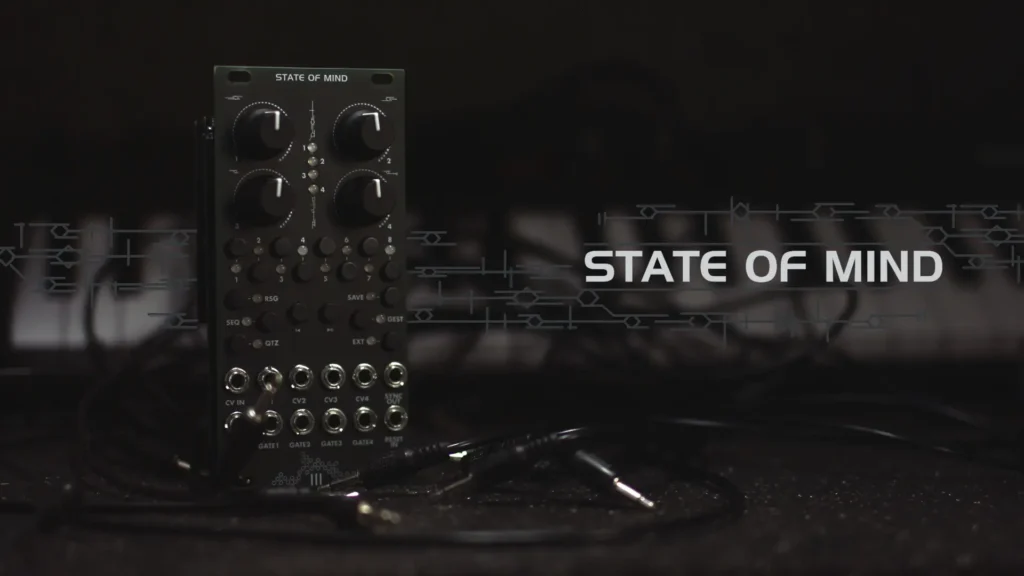
State of Mind is our Eurorack workstation. Four channels of CV, four gates, and multiple Engines that move them. Any channel can use any Engine, and different channels can use different Engines at the same time.
SEQ - Sequencer
In this video we want to show you State of Mind’s SEQ (Sequencing) engine.
SEQ moves through your saved snapshots. What is a snapshot? A snapshot holds all four channel voltages at the time you saved them, and State of Mind keeps eight of them. Put them in any order and SEQ plays them in a loop.
How it gets from one snapshot to the next is up to you, jump straight to the next, glide, or morph slowly across the whole step, with eight shapes to choose from. The rate runs from one step every twenty seconds for slow modulation to twenty steps a second, and the speed control pot is tapered so most of its travel covers musical tempos. Add swing and play forward, in reverse, back and forth, or in random order. You choose!
Every channel can go its own way. Give each channel its own clock division, its own shape and its own swing, so a bass line can move every four steps under a melody that moves on every one. Each channel also has its own gate pattern and gate length control.
Scenes take things even further. A scene saves all eight snapshots together with their sequence, tempo, shapes, swing, clock divisions and gate patterns, and State of Mind holds eight scenes. Switch scenes while it plays, and the change waits for the end of the loop, or chain them in any order to make a sequence of sequences.
In this patch, State of Mind controls the pitch of two oscillators, one playing the lead and one the bass. All four of the lead oscillator’s waveforms go through Permida, and State of Mind chooses which one plays when. The bass goes through Shape Mod, and State of Mind moves the wave shaper’s CV with a continuous shape, so its tone morphs smoothly from step to step.
GEST - Gesture and CV recording
State of Mind can record what you play. GEST records two kinds of things. Knob movements, and CV with gates.
Knob gestures. Turn any of the four channel knobs and GEST records the movement: a filter sweep, a slow swell, a modulation shape drawn by hand. You name it.
CV + Gate. Patch in any source, a keyboard, a sequencer, an LFO, and GEST records it as real voltage, a thousand samples a second, up to 48 seconds per take, negative voltages included. It plays back exactly as it came in, so a take works for pitch as well as modulation. A take can wait for your first note, and it can fit itself to the length of what’s already playing.
Each channel holds its own loop, so you can record one, layer the next, and so on. The whole four-channel arrangement can be saved to one of eight slots, to be recalled or chained into a sequence.
GEST can also be combined with other engines. One channel can loop a recorded sweep while for example RSG plays melodies on the others.
RSG - Random State Generator
RSG is State of Mind’s random melody generator. With the Musicality control you can choose between true random voltages, that can be quantized or played as they are, and structured melodies that play like a song, or anything in between.
At full Musicality, State of Mind takes a random stream of voltages and applies a set of musical rules to it. Essentially, it writes songs. Each time a song starts, each of the four voices draws its own character: where it sits in its range, the rhythm it leans on, a melodic shape it keeps coming back to.
Every voice has its own pitch CV and its own gate, and the gates carry the rhythm: which steps play and which rest, how long each note is held, when a note ties into the next. It pushes against the beat, leaves space and holds notes where it wants to.
Depending on the mode you set, the four voices work together in different ways. They can play chords with the lead, move beneath it in fifths and octaves, hold a chord tone, answer with a line of their own, sit on a bass note, or each go its own way entirely.
Why do we call State of Mind a Workstation? Well that’s because it can do a lot more than making random melodies. Stay tuned to find out more of what SoM can do.
More to come…
SEQ, GEST and RSG aren’t everything State of Mind does. There is one more engine, and plenty of other features, that we will show in the full demo video at release on 16 October.